
Author: Josephine Bernoth-Doolan is an ASD and ADHD Relationship Counsellor at Lighthouse Relationships
Neurodiverse people are much more likely to have intrusive thoughts. They are also more likely to struggle to define ‘who’ they are, for many reasons. This makes it easy for people to identify with the self as what we think – surely, if I think and therefore I am – what I think must make me who I am?
A lot of us are taught from a young age that they are. These experiences can range vastly in intensity and perceived impact. It can be something as serious as religious trauma to a throw-away line many of us have heard as a child: Don’t think like that. These teachings show us that we are what we think – and therefore, what we think can be Wrong, and is indicative of the person we are. But we are not. The very underpinnings of intrusive thoughts, and thought crime, show this.
What is thought crime? Not just for those with ASD and ADHD!
Thought crime originates from George Orwell in around the 1950s. Originally it meant to hold beliefs that were unorthodox to current social norms, and therefore punishable by authorities. Over the years the definition has expanded. Today, the idea of thought crime is relevant to free speech laws, cancel culture, a whole litany of things! Essentially I’d say that currently, thought crime is the idea that your thoughts are your actions. If you think about robbing a bank, for example; you’ve morally robbed a bank.
Don’t worry, dear reader. You have not robbed the bank. That’s the thing: thought crime is not real.
Well if it’s not real, what is it?
I’m so glad you asked! As always, please bear in mind that I am simplifying things for ease of understanding. What I am about to say is not a hard and fast rule, nor is it the only way to think about these things. However, it is also something that I’ve noticed quite genuinely.
There are, broadly speaking, two types of ‘thought crime’:
- Genuine thoughts
- Intrusive thoughts
Genuine thoughts are exactly as described. Thoughts that you genuinely have, and may follow through on. Let’s continue with the bank robbing example.
Genuine thought: I, James Bond, want to rob a bank. Hm. How will I do that… I know! I will use the sewers to connect my way under the bank, enlist the help of my trusty sidekick Q to falsely trip the fire alarm; and I will use the distraction of that and the construction across the street of the bank that I saw a few days ago to drill upwards into the safe room, stuffing many gold bars and cash stacks into a duffelbag, and escaping off into the night!
This is an actual plan to rob an actual bank (that would obviously go terribly unless you truly are James Bond). This is thought crime in the most literal sense. You have thought of a crime that you plan to take place.
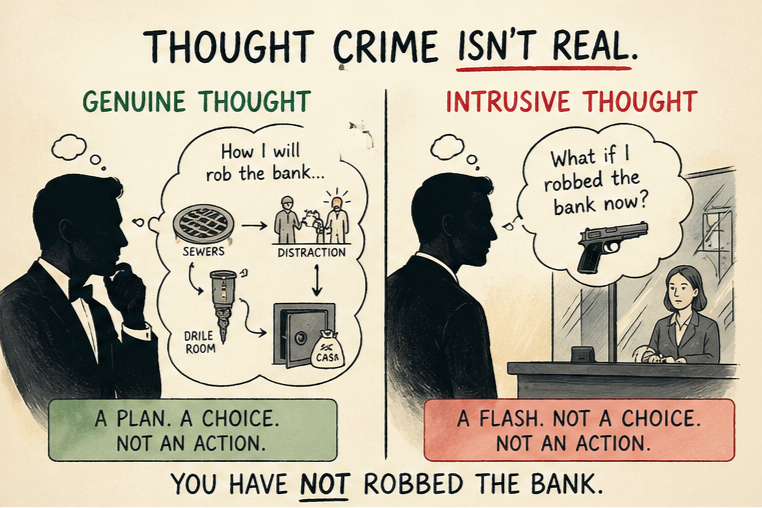
However: You have still not robbed the bank yet. You want to rob a bank, you have a foolproof plan to rob a bank, and… You still might not do it. Q says no, what then? The construction across the street finishes up the day before you plan to conduct your completely necessary scheme. What now?
The bank stays unrobbed, that’s what. You literally ‘committed’ thought crime: and it still isn’t real. Nothing has happened in reality. It has every chance of staying not real, and that bank going unrobbed for the rest of its banking life. No tellers were harmed in the making of this thought, roll credits.
Intrusive thoughts are different. An intrusive thought is more likely to go something like this: James Bond walks into his bank, to do some banking. Without warning he thinks Oh God I’m going to rob this bank, or, What if I robbed the bank now, or, tell the teller to empty the f*ing thing, or images of him pulling a gun might appear. He may reach the teller and his hands might twitch with the oncoming thought to slam her head on the bench.
This seems, in some ways, much more scary - intrusive thoughts feel like you don’t have any control over them, and indeed, when you get them you may feel as though you are not nearly as in control of your actions. James’ hands flinched – doesn’t that mean something?
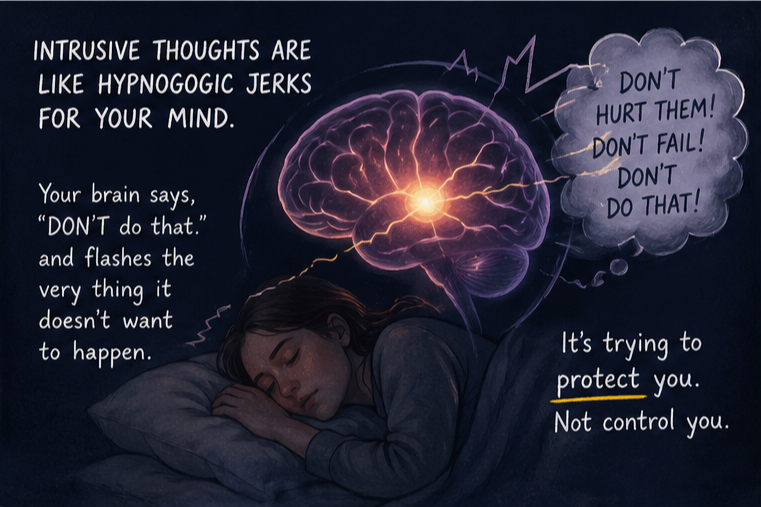
It does mean something. It’s just that all it means is that his hands flinched. In many ways, intrusive thoughts are a conscious version of a hypnogogic jerk. In a hypnogogic jerk, the act of falling asleep too fast means your brain jolts your nervous system in an attempt to keep you alive (as we currently understand it). In an intrusive thought; your brain flashes the very thing that it does NOT want to happen into your mind in a very full-frontal, and often anxiety inducing way.
Our brains are amazing and powerful things. They are also imperfect. They are built to pattern match: and they are built to keep us safe and to stop us from doing things that we don’t want to do.
WHATWOULDHAPPENIFYOUPUTYOURHANDONTHESTOVE is the brains best estimate of translating ‘do not put your hand on the stove, we need to be unhurt, we need to be safe’ in the fastest possible way to do things.
Intrusive thoughts and “thought crime” fears can place a quiet but significant strain on relationships—leading people to withdraw, over-disclose for reassurance, or question their own character in ways that disrupt trust and emotional safety. In relationship counselling, making sense of these thoughts can help partners respond with greater clarity and compassion, rather than fear or misunderstanding. As individuals learn to separate their identity from their thoughts, they often become less reactive, more open, and better able to communicate what’s really going on underneath. This creates space for a steadier, more secure connection built on understanding rather than anxiety.
Intrusive thoughts and the role of ASD & ADHD Relationship Counselling
Intrusive thoughts and “thought crime” fears can place a quiet but significant strain on relationships -particularly for individuals who may already be managing heightened sensitivity, anxiety, or ADHD-related emotional intensity. These experiences can lead people to withdraw - or, on the flip side - to over-disclose in search of reassurance. People may question their own character in ways that disrupt trust and emotional safety.
In relationship counselling, these thoughts can be explored in a way that reduces fear and misunderstanding, helping partners respond with greater clarity and compassion. As individuals learn to separate their identity from their thoughts, they often become less reactive, more open, and better able to communicate what’s really going on underneath. This creates space for a steadier, more secure connection built on understanding rather than anxiety. In this way, through the development of some very learnable skills, intrusive thoughts can actually be turned into a source of connection.
This is all great and all; but what am I supposed to do about it?
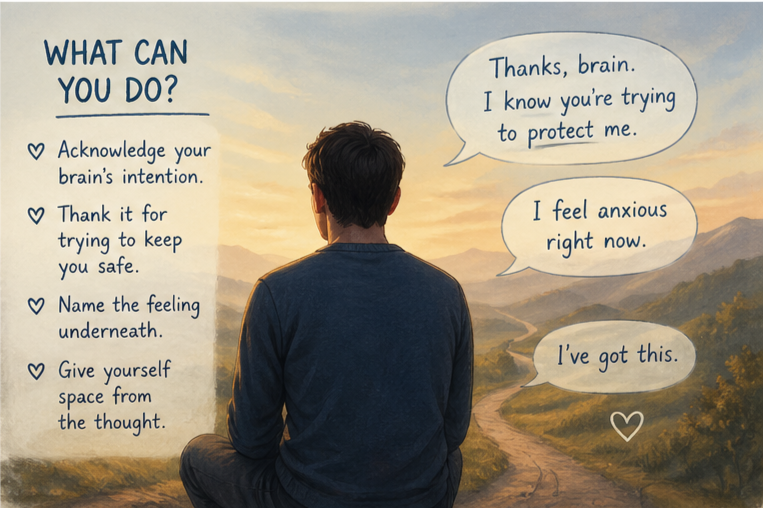
We acknowledge what our brain is trying to help us with. It is doing the best with what it has! James Bond will say “Thank you, brain, I really appreciate you trying to tell me not to use my training on civilians. I know not to do that.” in his mind. “Ah, thanks brain, I know I’m anxious about this, but I think I have it under control,” to ‘YOUREGOINGTOFAILTHISTEST’. By addressing the root feeling underneath the thought, we give space in ourselves to have this feeling, and to give us some space from the thought.
About the Author
Josephine Bernoth-Doolan is an ASD and ADHD Relationship Counsellor at Lighthouse Relationships, where she works with individuals and couples navigating neurodiversity, identity, and emotional regulation. Holding degrees in both psychological science and counselling, she has a rare depth and breadth of expertise. She has a particular interest in helping clients understand their thoughts, reduce shame, and build a more grounded sense of self. Her approach is warm, practical, and always grounded in solid science. Josephine is passionate about supporting neurodiverse clients to feel understood, empowered, and more in control of their inner world.
To learn more about Josephine and her approach, you can visit her full profile here.